This is Faith in Play #100: Sacrifice, for March 2026.
There is an aspect to many religions, particularly ancient ones, which we moderns find distasteful–yet it is meaningful, significant in ways we often fail to consider. That aspect is sacrifice.
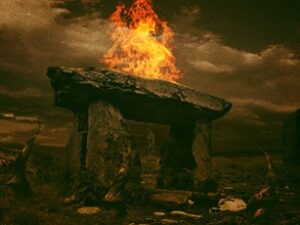
We tend to think that this is barbaric, yet we overlook the fact that it is an integral part of our Christian faith, in various ways. We downplay the detailed and copious requirements for sacrifices in the Old Testament, and proclaim that the sacrifice of Christ put an end to those–but then, that crucifixion was a sacrifice. It appears that not only could Jesus have avoided going to the cross altogether, not only could He have come down from the cross had He so chosen, He chose the moment when He stopped fighting to keep breathing, to keep Himself alive, and chose to die. He sacrificied Himself.
It is also true–although not universally practiced–that “giving up for lent” is a form of sacrifice. No, we don’t kill anything, but there is a sense in which we die to a desire. Besides, when we speak of the sacrifices under the Law, we tend to think of the bulls and goats and sheep and doves slaughtered and put to the flames. We overlook that there were also sacrifices of fruit and grain and vegetables, the firstfruits of the harvest, delivered to the tabernacle and later the temple, as sacrifices.
The point of sacrifices is that they cost something. Whether you give it to the temple or the church, or to missions and good works, or simply give it up, it is a tangible price, something paid, something lost. The money we drop in the offering plate is in a very real sense a sacrifice, something we have chosen to do without, from which to be parted.
There are fundamentally three reasons why sacrifices are made.
The one which appears to us in other ancient religions is the notion of paying a god for a favor, that is, requesting an answer to a prayer. This thinking in essence says I’m asking my god to do this on my behalf, and I’m paying him something to entice him to do it. I’ll give up my valuable hen, my prize bull, my virgin daughter, so that the god will give me rain, crops, healing. It’s a tit-for-tat arrangement, a bargain, a deal. We frown on such sacrifices–yet we often try to make them ourselves, when we say, “God, if you will, I will.” We offer to make a sacrifice, to give up something, in exchange for a gift or blessing. It’s not biblical, but we do it.
The sacrifices of the Old Testament are actually the reverse of that. They are more on the order of God saying, “You owe me; pay up.” In many cases they were a thank you for blessings granted, such as the harvest. They were also payment for forgiveness, grace given, as sin caused a debt to be settled. When a first son was born, a sacrifice was required because God spared the firstborn sons of Israel and gave them back to their families in exchange for Him being given the Levites.
Some sacrifices, such as those offered at Lent, are made as deprivations of selfishness, that is, I do without this as a way of recognizing that I don’t need it, that I do without. It is the practice of poverty, of simplicity, that says that God is enough, and what God provides is enough, and I do not need more than that.
Of course, the practice of sacrifice has been abused by some. Sacrifice is supposed to cost something from the one making it. In some cultures, enemies were sacrificed, or children, or undesireable members of society, and the ones making the sacrifice lost nothing. It was supposed that the god would be pleased to receive the sacrifice of a person, any person. There is a flaw in such thinking, but it was not recognized by those who in essence sacrificed nothing when they made their sacrifices.
All of this is background to inform gameplay. There will be religions that require sacrifices of one sort or another, whether in ancient history, modern culture, or future societies. Consider who sacrifices, what is sacrificed, how, when, and why. It’s a critical part of the religions of your worlds. But it’s also important for us to remember the place of sacrifice in our own lives.