This is Faith in Play #107: Zombie Apocalypse, for October 2026.
I want to thank the members of the Christian Gamers Guild for their suggestions for this article. I’m going to have to consider writing about The Science of Magic and The Magic of Science in the future. This article was inspired by comments in The Min-Max Podcast.
I’m not fond of zombie apocalypse stories; I find them implausible, although working with Eric R. Ashley I included one in the Multiverser novel In Version, and my novella Corpoise is about a zombified dolphin in the Delaware River, so I am familiar with the concept. I just don’t find it all that compelling.
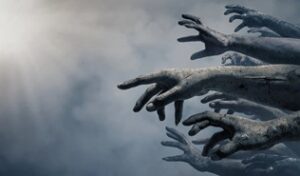
Apparently, though, there are people who do. There is a popular play-anywhere game in which a group of people are gathered together for some other purpose–restaurant, party, study group, whatever–and one of them announces that it happens right now, what do we do? The group then assesses their resources and potential strategies to stay alive against an invasion of zombified humans, how to protect themselves, whether they have any available weapons, and how they can get to a safer location.
I admit I was not particularly impressed with this as a game idea. I realized, though, that that’s partly because of my own incredulity–I consider such an event unlikely in the extreme. But then I remembered watching the original (1984) movie Red Dawn, and wondering how I might respond to a communist invasion (woefully poorly, I’m afraid). In some ways the ideas are not that much different: how do you defend yourself against an invader when you are just an ordinary person with relatively ordinary supplies?
In my case the answer probably is, I don’t. Somewhere in the house I have a kau sin ke, a gift from players at my table years ago. I take it with me to conventions mostly as a prop. I did play around with it a bit maybe thirty years ago, learning how to do a few defensive and offensive maneuvers with it, but I can’t say it would be any use in combat–that was mostly to see whether the moves I envisioned my characters making were plausible. (The Lauren Hastings character in the Multiverser novels duplicates many of those moves, and others, and they are in some ways the basis for the combat techniques for Derek Brown’s chain and Tomiko Takano’s kawanaga.) Facing zombies, were I mistaken in my disbelief, I would be rather helpless. I can imagine ways to fight them, but I doubt I could actually accomplish them.
I’m not worried about it, though, because as I suggested I find a zombie apocalypse highly implausible–less plausible than a communist invasion, which I think too unlikely to be worth worrying about. I think a nuclear attack is more likely, but then, I grew up in the sixties and read On the Beach and Alas, Babylon in high school senior English, so the world then was filled with people fearing a nuclear attack–although I was just a bit too late for air raid drills and hiding under your school desk exercises, as if that would help. A friend of mine from the army (no, not Bob) confided that soldiers were taught they could survive a nuclear attack, so that believing this they would continue to fight after it happened. However, I digress.
From a game or story perspective, the zombie apocalypse is the kind of horror, as previously observed, in which hope is stripped away bit by bit until only despair remains. That is one reason I believe it will never happen: no matter how dark the world gets, God is on the throne, and nothing is outside his control. His plan is unfolding in the world. We can’t from our perspective see where it ends or how it gets there, but we know that we are in Sovereign hands.
So the zombie apocalypse, like the communist invasion, is an intriguing thought experiment, but not something about which anyone should genuinely worry.
Previous article: Choosing.
Next article: Mentoring.